





















































Imagine, in about a decade, you turn on the news and see that water is being withheld in your area, as we are starting to run out of it at an alarming rate. You rush to your kitchen sink and turn on the tap, but to your surprise, there is, in fact, no running water.
You ask yourself why this is happening, but the news anchor on the TV, almost seeming to hear you, answers your question. One of the causes is the use of artificial intelligence (AI).
AI is not a touchy subject for most, as it is seen as an advancement in technology that has rapidly entered the mainstream. While AI is typically seen as a good thing, that is not always necessarily the case.
When it comes to AI, there can be concerns about water and energy consumption, impacts on cognitive thinking, and safety and reliability.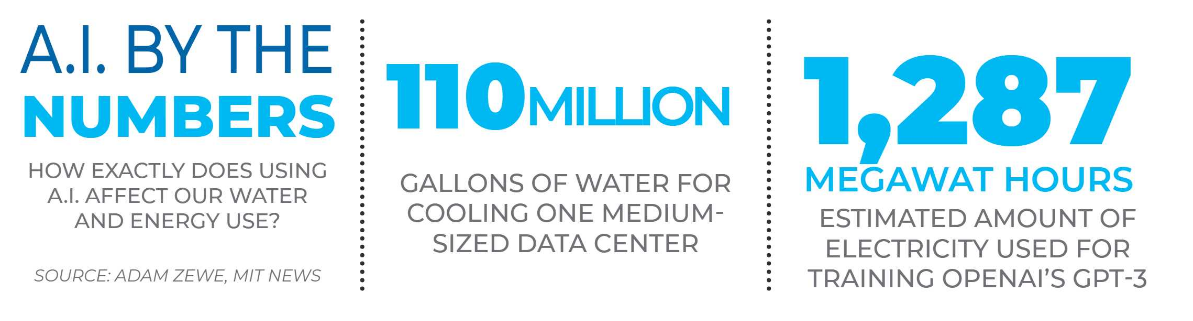
People claim it is a tool that can be used to assist and help productivity with jobs and advances in science, but is it really what people say it is, and what impact is it really having?
As I said, AI is what many people call a tool, but it takes energy and water to compute and generate responses. They not only have to train these models, which also consume energy and water, but AI still consumes these resources once training is over.
ENERGY USAGE
In a 2021 research paper from Google and the University of California at Berkeley, scientists estimated that the training process for AI took 1,287 megawatt hours of electricity, which is enough energy to power about 120 average U.S. homes for a year, and the Environmental and Energy Study Institute states that the average chip manufacturing facility uses 10 million gallons of water a day. A single chip installed would have already consumed thousands of gallons of water by the time it reaches the site.
Every time a model is used, the computing hardware that completes these operations consumes energy. Researchers at MIT Climate and Sustainability Consortium have estimated that a ChatGPT search uses about five times as much electricity as a typical web search.
“Plus, generative AI models have an especially short shelf-life, driven by rising demand for new AI applications. Companies release new models every few weeks, so the energy used to train prior versions goes to waste,” says Norman Bashir, the lead author of the MIT impact paper and a Computing and Climate Impact Fellow.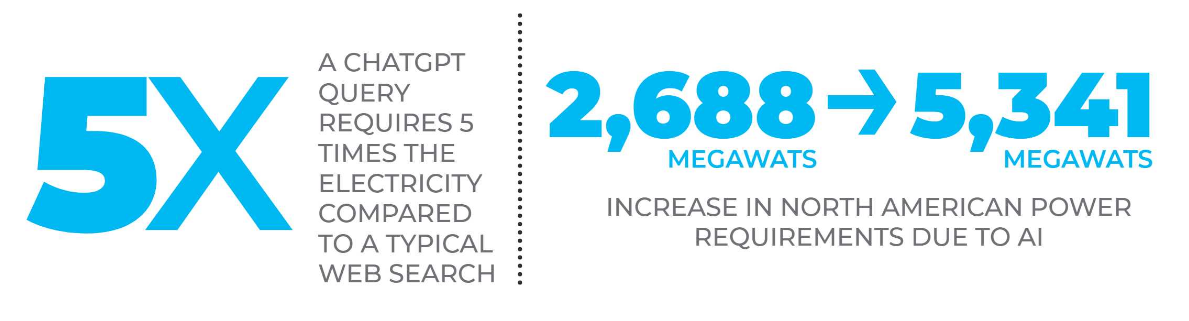
Scientists have also estimated that the power requirements of data centers in North America increased from 2,688 megawatts at the end of 2022 to 5,341 megawatts at the end of 2023, which was in part due to the demands of generative AI.
Although I believe we can and should live without it. My question is this: if demands continue to increase and scientists do not find a way to divert more renewable energy into AI, what does that mean for our future?
Not only do AI computations and training take fossil fuels, which contribute to greenhouse gas emissions and use energy as previously stated, but it—more worryingly—uses cold water.
The Environmental and Energy Study Institute explains that computations in data centers cause the chips in the computers to overheat, which can potentially cause damage. This is where the cold water I previously mentioned comes in.
WHY WATER?
According to scientists at the University of California Riverside, every 100-word AI prompt uses about one water bottle of water.
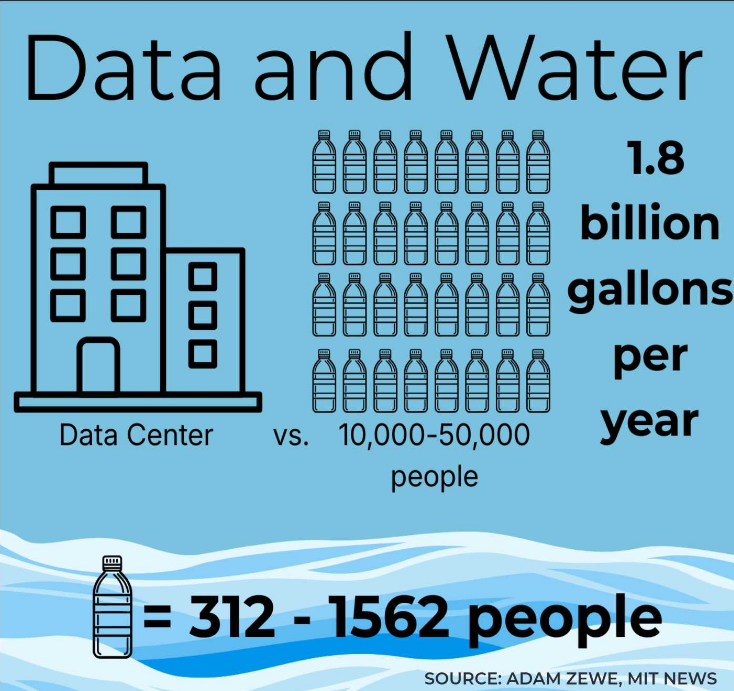
The Environmental and Energy Study Institute also states that medium-sized data centers can consume about 110 million gallons of water a year for cooling, which is equivalent to about 1,000 households’ water use. If this is not concerning enough, larger data centers can use up to five million gallons per day, or 1.8 billion gallons per year. Which, to put it in perspective, is the water usage of a town of 10,000 to 50,000 people.
Most of the time, we are unable to get this water back, as the water evaporates from the local cycle into cooling towers. Here, the water escapes as vapor. There are other alternatives to this as well, including water management techniques that reduce water consumption.
These include closed-loop cooling systems, air cooling, immersion cooling, and using non-potable water sources (such as recycled wastewater and captured water).
Closed loop systems reuse recycled wastewater and freshwater, which allows water supplies to be used multiple times. Cooling towers can also use external air to cool heated water, allowing it to return to its original temperature and reducing freshwater use by up to 70%.
If we do not use our resources wisely and use these alternatives while billions of AI users worldwide enter prompts into systems every minute, what does this mean for our water supply in the future?
LOOKING AHEAD
The United Nations headquarters issued a warning on Jan. 20, 2026, that the planet is entering a “water bankruptcy.”
The leader of the United Nations University Institute of Water compared this issue to finances, saying that “In finance, when you spend more than you earn for too long, you go bankrupt. We have done exactly that with our water ‘checking’ and ‘savings’ accounts.”
Some blame this on global warming, and some blame it on AI, but my fear is if thousands of people are contributing to water consumption because they “don’t have time for their homework”, which they could have made time for, or “need a cartoon photo of themselves”, which they could have commissioned an artist for, what will that mean for water in the future if we are already entering an era of water bankruptcy?
Well, I personally fear that it is going to cause a lot of issues, and that people will not start caring until we run out of water. Therefore, the time to act is now.
Stop using AI. Do not use it for help with homework, instead ask a teacher to explain something to you. Do not use it to generate an image, try to draw it yourself or ask someone else to. Share the information and statistics in this column with other people, and always keep these things in mind.
While water consumption is a major concern with AI, it is unfortunately only the start.

Zollen Lione • Mar 13, 2026 at 9:59 am
Why is Everyone So Wrong About AI Water Use??
a personal video by Hank green
this was a pretty good video explaining AI water usage in immense detail, not that this article is inaccurate, just more info
AI’s practical and economic application has been very limited, so we’re dumping money into something with pretty low returns, and children are making it think for them. Even if the water usage isn’t concerning (video explains why I’m less concerned about the water), its just doing something for practically nothing, or possibly even something harmful, we haven’t even decided on if we as a society support AI yet. It’s very concerning that our economy relies so heavily on AI.