















































For years at Floyd Central, students had different choices for their English credits, especially for upperclassmen. They could take one of four classes: general English, honors English, Advanced Placement (AP) Language & Composition or Literature. However, the school district’s administration has made the choice to take it a step further and discontinue two courses: English 11 Honors and English 12 Honors.
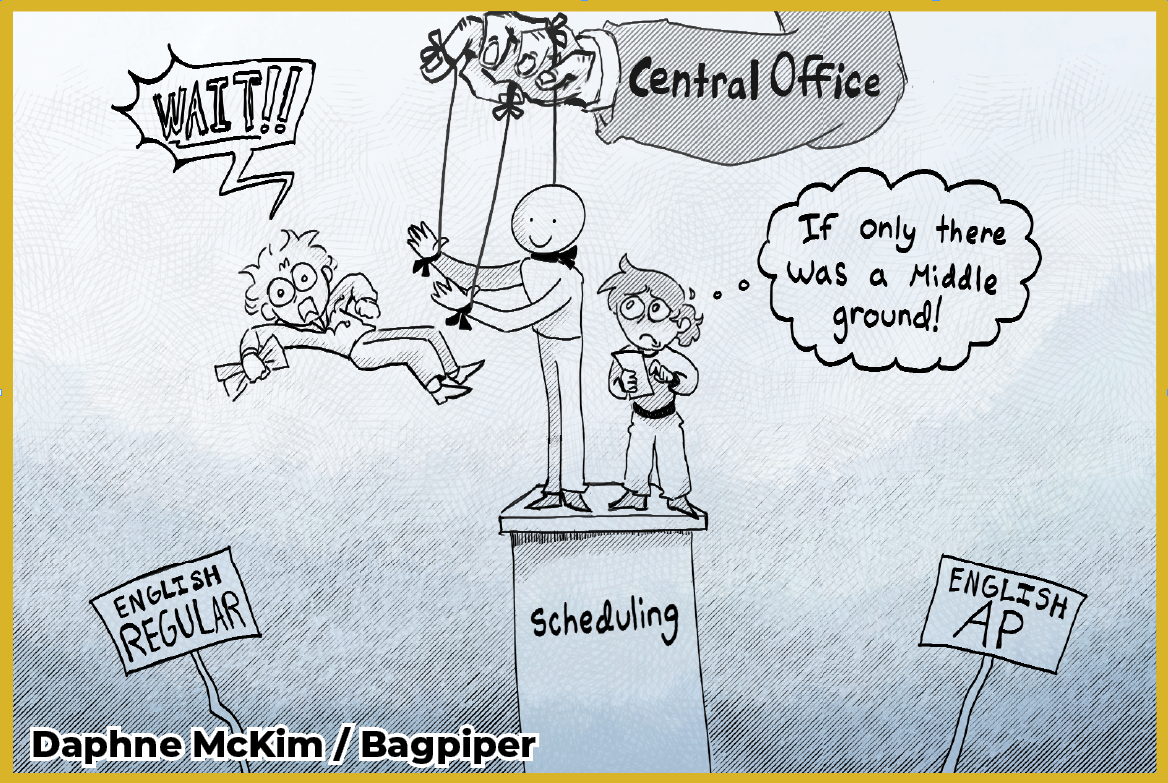
The Bagpiper believes that discontinuing these courses will only cause harm to FC students and create further division in learning abilities in the higher-level English classes, and this harm can only be undone by bringing back the middle ground.
Junior and senior year, many students must decide where they plan to go and what path they want to walk after high school. Some students do not have the abilities required in an AP course, yet many have abilities that are above general English.
Specifically in English 11 Honors, many students who signed up for this course were not ready to take AP Comp, but they still planned to pursue the AP Lit class their senior year so that they could receive the Indiana College Cord Certificate (ICC). English 11 Honors had prepared juniors for taking this class the following year, still giving them the chance to receive their ICC, but giving them time to prepare. This class was a perfect middle ground for juniors, as it took aspects from AP Lang and general English 11, so even honors students who were not pursuing an AP English course had a class to take.
In English 12, there is an apparent difference between general and honors. By senior year, many students have at least made the decision if they will be pursuing their career or attending college. While English 12 Honors was not as heavy on seniors as AP Lit, honors was used to prepare students for higher education. Comparatively, general English 12 is designed to be more career-orientated. Both classes were similar in some regards, but were drastically different in their goals for the students.
This decision to discontinue the classes is going to lead to increased numbers in AP classes, but why would we push students this way?
Some students are going to feel pressured to take the hader classes that they simply are not ready for. So it will lead to one of two things: Students will be shoved into advanced classes that they inevitably fail, or the AP class itself will have to drop its standards and rigor for the students falling behind.
Not only is this incredibly unfair to the students who need to be in honors, but also for the kids who are prepared to take AP classes. Advanced classes are very tight for time, often fitting many different lessons into a one-week timeslot. So, if teachers are needing to slow down their AP classes, this may lead to them falling behind not being able to properly prepare the students for their AP tests in May.
A similar thing may happen if they are forced in the opposite direction of general English.
While these honors students are feeling like they are not being challenged, they may act out from boredom in general classes.
Students not wanting to take an AP class will be shoved into general English classes, leading general English teachers to either be unable to challenge these students or having to raise the class’s standards to meet their pace.
For the students who belong in general English, this is unfair for them. If the standard is raised, many students in general English may struggle, despite the point of the class needing to be less rigorous than an honors or AP class.
On the other hand, if general English remains as is, these honors students will be slowed down from the lack of rigor and will not be properly prepared for college.
Discontinuing these two honors courses will unbalance the skill level in the AP and general classes. This middle ground is essential, as most kids do not fall into one or another. Removing English honors classes is not only unfair and careless to do to the honors students, but it will take away the chance to learn for general and AP students.
Differentiation in students’ education should be the top priority, but this decision proves that it is not always treated as such.