





















































You’re sitting in class working on a worksheet, and you’re not sure what the question is asking. The words seem to melt together and not create a coherent sentence, so you decide to open ChatGPT or Gemini in a separate tab and ask AI (Artificial Intelligence) to explain it to you.
As it summarizes the question, you realize that you can use it to help you when you’re confused in general (or don’t want to do the work). You think, “how helpful,” and decide to start using it more for help with your schoolwork in the future.
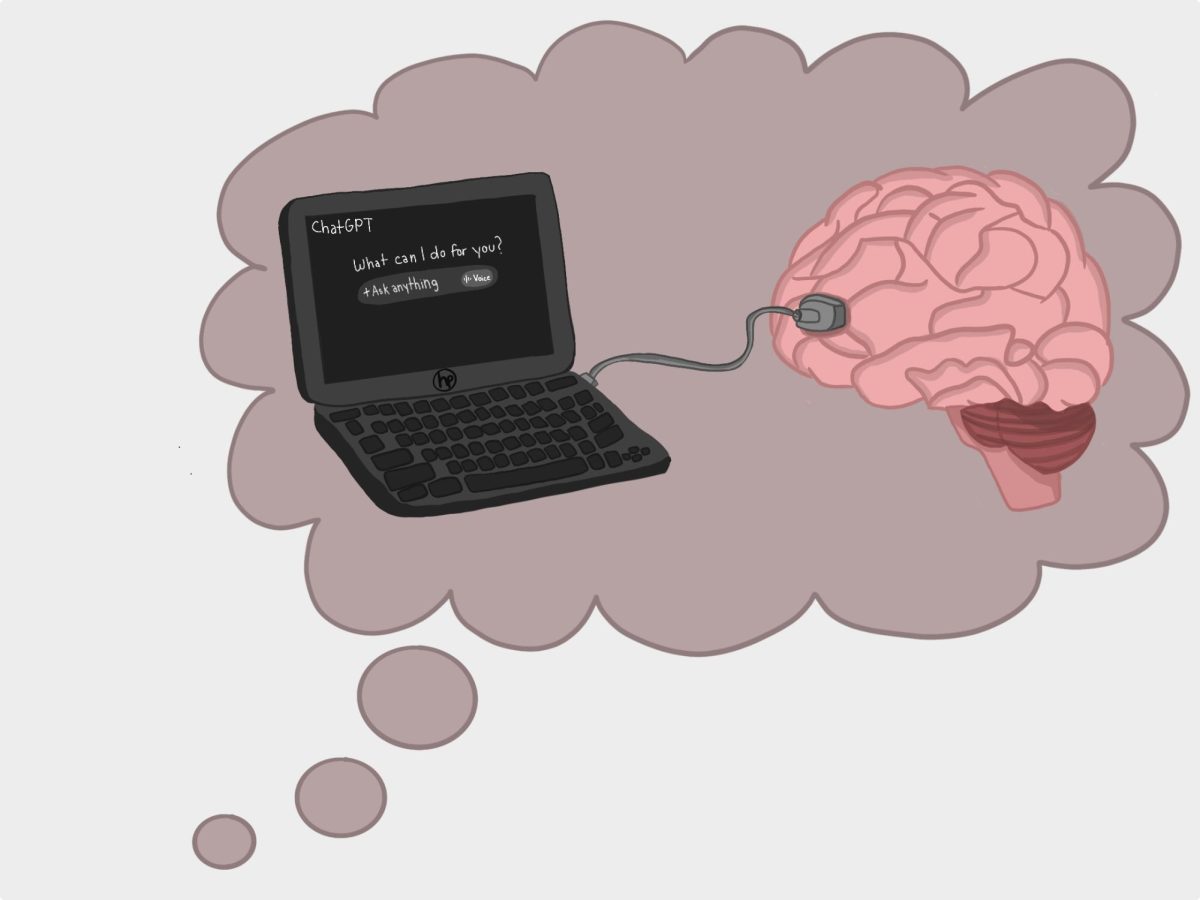
Through this process, you are unknowingly becoming reliant on AI in the future, and possibly, in time, for answers when you eventually can’t think for yourself.
Maybe this sounds like you, or maybe it sounds like a classmate that sits next to you. No matter what your experience is, not many people agree with me that AI is bad for your ability to think, but new evidence shows that I’m not far off from the truth.
This evidence I’m suggesting that supports my thought process comes from a study that was conducted at MIT’s from their Media Lab, and it only heightens my concerns.
The study divided 54 people into four groups: a group that had access to an LLM (Learning Language Model [or a form of AI]), a group with access to a search engine (e.g., Google or Safari), a brain-only group, and a brain-only group that would later have access to an LLM.
These groups were assigned to write three different SAT-style essays while using electroencephalography (or an EEG, which records brain waves), to record participants’ brain activity “in order to assess their cognitive engagement and cognitive load.”
Basically, cognitive load is the effort your brain uses to process and memorize different things. If you’re relying on AI (or copying an answer down directly from what the AI said), you won’t be able to remember what the AI is telling you the same way you would if you were to read it in a textbook or or find it on a website through a search engine (which is also supported in the study I referenced above if you want to look into it).
So if people who used the LLM (or the AI) were reported to have lower cognitive load, that means they aren’t remembering all of what they wrote in their essays.
This is further proven by the results, which state “The reported ownership of LLM group’s essays in the interviews was low,” and “The LLM group also fell behind in their ability to quote from the essays they wrote just minutes prior.”
This is worrisome because if AI users at our own school and others across the state and even the world aren’t committing things to memory and become reliant on AI in the future, nobody will learn anything. What will that lead our society to when people cheat their way through college and don’t know how to do their job? For example, how would you feel if you had to have surgery, and your surgeon was asking ChatGPT how to perform it right before you went under?
In addition to this, an interpretation of the study’s findings concluded that there are reports of “cognitive offloading to AI,” or, simply, reliance on AI systems. They claim that “reliance on AI systems can lead to a passive approach and diminished activation of critical thinking skills when the person later performs tasks alone [3].”
This basically means that people who use AI are losing their ability to think for themselves over time, as they’re not processing any information and are letting something else think for them, rather than thinking for themselves. Furthermore, if you’re not not thinking for yourself, like anything, you will start to lose that ability in the future as well.
To put that simply, if you don’t exercise a muscle in your body, such as your legs, and try to run 10 miles, you’re going to fail because your body doesn’t have that practice over time. It’s the same thing with AI. If you don’t use your brain, over time, you’re not going to be able to use it.
And if people are turning straight to “sources” like Gemini, ChatGPT, or Google’s “AI overview” instead of even trying to do research, what does that mean for them in the long run?
I fear that, as a society, we’ll slowly start to lose the ability to think, work, and be competent. What happens when it starts to take over jobs, resulting in people not being able to make a living and impacting you and others like I stated earlier? What happens when it starts to take over our creativity and humanity, in turn disconnecting us from each other and what makes us human? What happens when it starts to deviate from what it’s programmed to do? What happens when it might already be doing exactly that?
What do I mean by this? Well, different AI programs have repeatedly been found to bring up answers that simply don’t exist.
Here’s the issue. The way AI is supposed to work is by scanning the internet for pre-existing information, summarizing it, and spitting it out back at us so we don’t have to do the research (and in my opinion, so we forcefully become reliant on it, are reduced intellectually, and so companies can produce more money than anything else, but that’s another column for another time). But on occasion, AI is finding answers from links that simply, and scarily, don’t exist.
Multiple sources, including MIT’s “When AI Gets It Wrong: Addressing AI Hallucinations and Bias,” and NCSC (which is a website that caters to law and legal practitioners and explains how this can impact their field negatively), discusses this phenomenon. This issue has been named “AI hallucinations.”
An article on NSCS’s website says, “AI hallucinations occur when legal AI tools generate fabricated case citations, distorted holdings, or false procedural information that appears authentic but doesn’t exist or is factually incorrect.”
Just because this website specifically caters to law doesn’t mean that the AI they use is the only form that has these hallucinations. MIT has reported that “tools” like Gemini, ChatGPT, and Copilot have been shown to generate data that isn’t true but appears real.
In addition to this concern, I’m going to go back to a point I had earlier about how AI works. AI scans the internet and spits out information at you from what it found. Generative AI is trained on many amounts of information on the internet, and while this gives it access to tons of knowledge, it doesn’t fact-check it.
Matt O’Brien, who is a technology reporter at The Associated Press, states in an AP news article, “Generative AI models function like advanced autocomplete tools: They’re designed to predict the next word or sequence based on observed patterns. Their goal is to generate plausible content, not to verify its truth. That means any accuracy in their outputs is often coincidental. As a result, they might produce content that sounds reasonable but is inaccurate.”
So if you’re relying on AI to do something simple like your homework, not only are you reducing your ability to think in the future, but you’re also trusting something blindly that is often incorrect. And people wonder why I think AI usage is stupid, and that’s just one out of the several reasons why I believe that.
Next time you think about opening that Gemini tab on your school Chromebook or ChatGPT on your phone, think back to this column. Think about what AI usage is doing to you and other people. And please, for your sake and for others, just use your brain and think for yourself.