

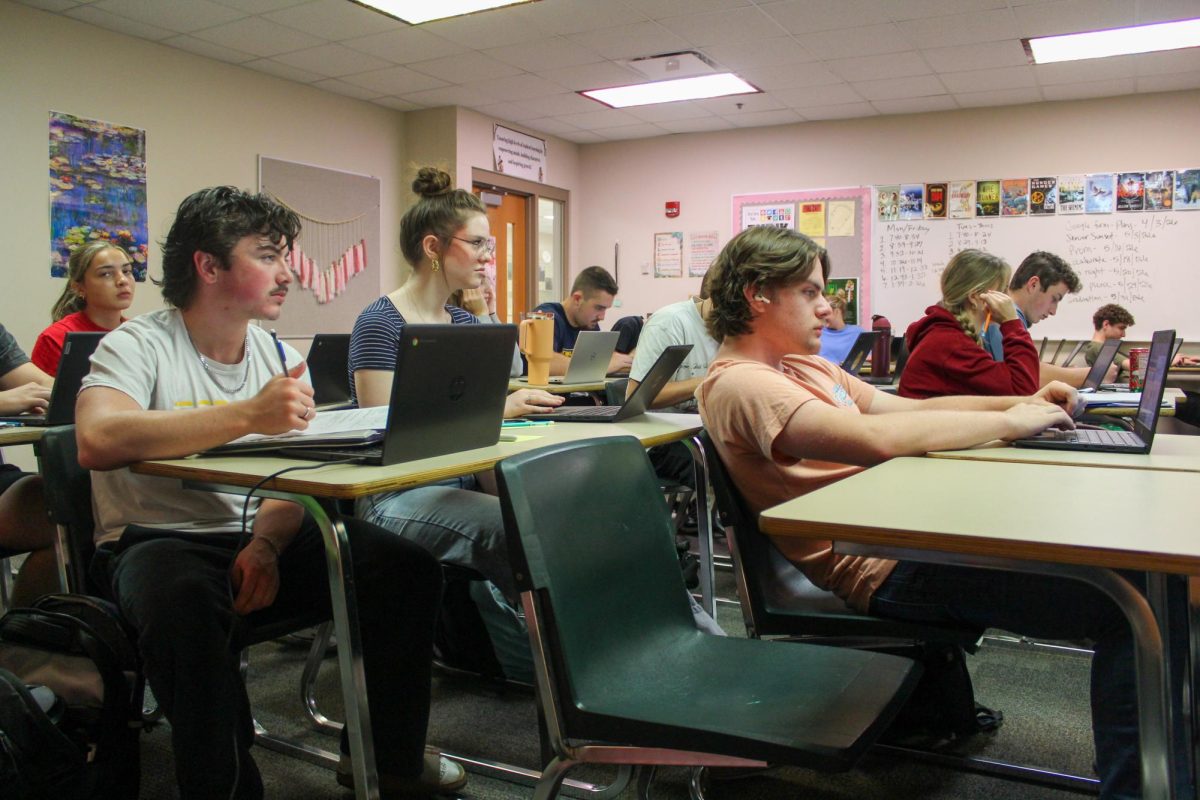












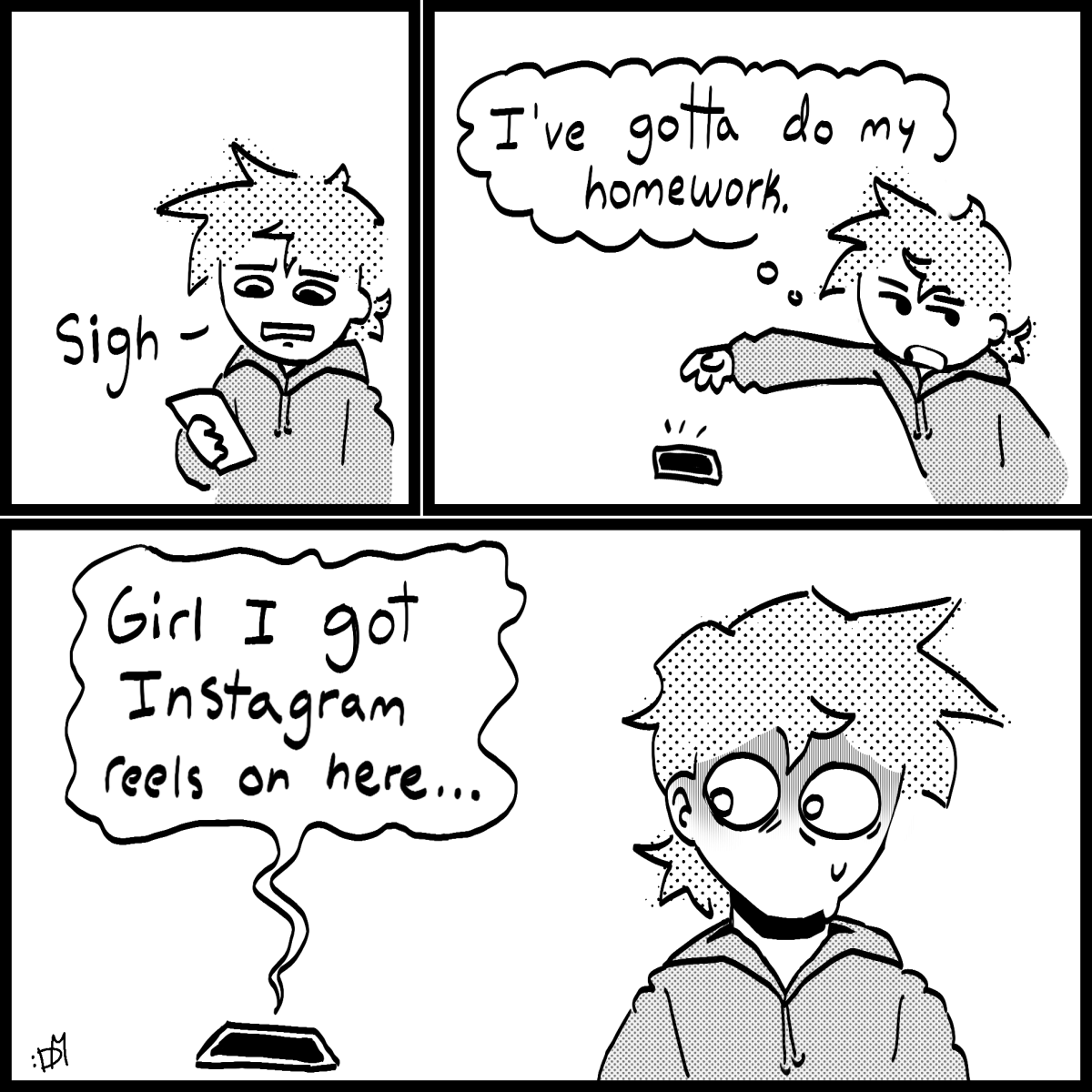








































A chin bows down as a phone is discreetly checked under a desk, or a phone is laid thoughtlessly on the edge of a table. In the halls of Floyd Central, phones are everywhere. Students can be found scrolling during passing periods, lunch, and, despite the rules, in class.
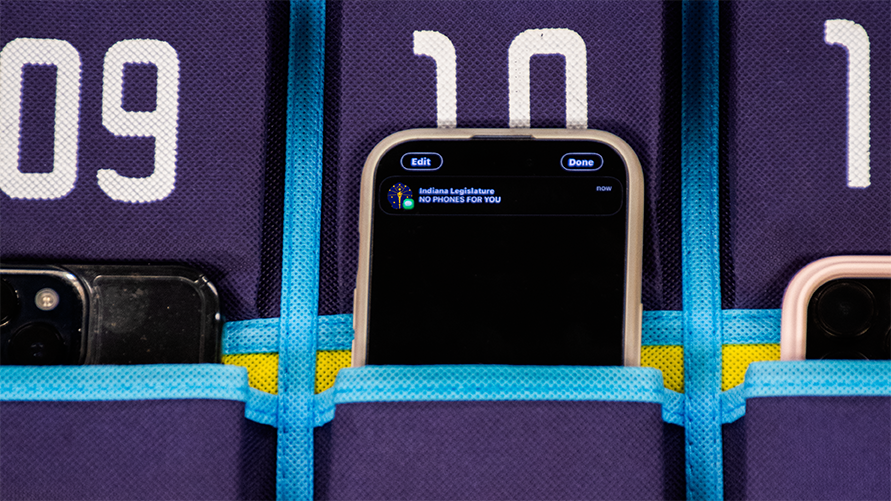
At the beginning of the school year, FC adopted the bell-to-bell phone policy that was laid out in Indiana senate enrolled act 185. The law is what currently dictates that students can only use personal devices during non-instructional time, such as during lunch or passing periods.
Despite the ban on phone use during class, according to a Bagpiper poll, 70.3% of the 283 student responses reported using their phones at some point during class. Despite students reporting using their phones often during class, the number of referrals written because of phone use are quite minimal.
“Since the first day of school, we have had 28 students who have received a referral for a cellphone violation, but many teachers will not refer them to the office. They may confiscate in class and never even tell us,” said principal Scott Hatton.
Whether teachers choose to write a student referral for using their phone during class or to just confiscate it for the period depends on a few factors.
“I kind of use my judgment on if it’s been a recurring issue or if it’s a student that I’ve confiscated the device from before. Usually, the first time, I’ll just take it for the period, but if it’s a student who has their phone out over and over again, at that point, I usually send it to the office,” said photography teacher Dakota Jackson.
The effectiveness of the current phone policy has been called into question by the author of the senate enrolled act himself with senator Jeff Raatz authoring senate bill 78 to try and expand on the regulations that began in his previous legislation. In an Indiana Capital Chronicle article Senator Jeff Raatz said, “The goal, Raatz has said, is to eliminate inconsistencies that allow phones during lunch, passing periods or at individual teachers’ discretion.”
Raatz’s concerns over inconsistency seems reflected by FC students’ experiences with the current policy, with one student claiming the policy is enforced to varying levels depending on which teacher’s class they are in.
“I have teachers who enforce the policy, but they aren’t super strict about it, but then I have really super duper strict teachers, that like if they see it they tell us to put it in our bags, and even if they see it like in our pockets we can get in trouble,” said freshman Cheyenne Vincent.
Senate Bill 78 will go into effect over the summer, with FC planning to adjust the school’s current phone policy accordingly.
“We are going to be talking about how to do this in a respectful and fair way. What is fair to students, what is reasonable,” said Hatton.
The bill, which will affect every school in Indiana, details a total ban of students using personal devices during the school day expanding the policy from just instructional time to reach all periods of the day. FC has yet to decide exactly how the policy will be enforced in the coming year, with the NAFCS school district still having conversations to ensure the policy is equally enforced across all schools.
The school district has a few different directions they could choose to take when it comes to enforcing the policy.
“They may say, ‘Put it in your backpack, put it in your locker,’ or they may say ‘don’t bring it into the school building.’ There are all kinds of choices. We just don’t know what that looks like just yet,” said Hatton.
Phones in the classroom have been an issue the school has been trying to solve for the past few years with concerns over how the constant access to distraction can affect students’ ability to learn.
“I think the phones are a major distraction, and students can use them for cheating. I also think that, in a lot of ways, phones contribute to anxiety, and I know that some people feel like they alleviate anxiety because it allows them to stay connected with their friends in social circles, but I think it’s not necessarily a good thing to have constant access to your personal life when you’re supposed to be learning,” said Jackson.
With students’ reliance on phones, the transition to a phone-free learning environment could come as a bit of a shock.
“We’re used to it being right there at our hands, so it definitely is going to be hard, but I think in the long run it’s going to be better. I know that a lot of students have said that they’re happy that they don’t have to have their phone. You know, it just, it forces them to do it, and sometimes unless somebody forces us to do something, we’re not going to. In the long, run it’s going to be better,” said math teacher Rebecca Cambron.
Some students believe the new bill is a bit of an overreaction, believing the issues with the current policy falls more on a lack of consistent enforcement than the policy itself.
“Personally, I think it’s overdoing it a little bit. I think the problem isn’t the laws, I think the problem is the fact that teachers aren’t enforcing it,” said freshmen Mylah Manecke.
Due to the inconsistent enforcement of the current policy, some believe that the new bill will not have much effect.
“I believe that they’re not really going to change much within the next year because there’s already a local law for it, and they already don’t respect it, and I don’t believe that the current policy changed anything,” said junior Drake Philpott.
Another critique of the policy comes from the safety concern over not having access to personal devices in the case of an emergency.
“I get why they’re doing it, but I think it’s kind of not necessary in some cases. Especially with the state the country is in. It’s very scary to get our phone privileges taken away when anything could happen any day of the week,” said Vincent.
With students already critiquing the new policy, the question becomes how many students will comply with the new policy.
“I think that if they make us put our phone in something that kids are going to end up either bringing in a fake phone or just not doing it at all, and it’s going to cause more problems than it’s going to solve,” said Vincent.
The administration recognizes that there will be difficulties with the implementation of the policy, but ultimately believes FC’s students will adapt to following the new policy.
“I think FC is different from other schools. What I have found is our students will push it a little bit, any kind of rule, but they will rise to the occasion. They want to do the right thing,” said Hatton.